

Britain is currently enduring its third heatwave of the summer, which is to say that the weather has been pleasant for slightly longer than we feel is constitutionally acceptable.
We are not built for this.
Other countries cope with heat in a calm, adult fashion. Americans produce sensible water bottles and hats. Australians lather themselves in suntan cream, move into the shade and carry on. Southern Europeans close the shutters, eat late and regard the whole thing as normal.
The British, meanwhile, stand in our kitchens in a state of damp disbelief, saying, “It’s a bit much, isn’t it?” while opening the fridge for no reason other than to look at somewhere cold.
The problem is that our houses are designed to keep heat in. This is admirable in February. Less so in July, when the bedroom has reached the temperature of the proving drawer and the sitting room feels like the tropical house at Kew Gardens.
Last week my daughter and her husband were visiting from Canada, so we decided to take them out on the boat. It was, in many ways, a perfect Dorset day. The sea was glittering, the sky was cloudless and the Jurassic Coast looked so beautiful it could have been designed by the Dorset Tourist Board after a particularly good lunch. There are days when this coastline still takes my breath away. Chalk cliffs, blue water, wheeling gulls and that wonderful sense that, if you look closely enough, the whole of history is sitting there in the rocks.
Unfortunately, there was also no wind.
Sailors spend most of the year yearning for sunshine, then the sunshine arrives and we remember that boats are basically floating greenhouses with ropes.
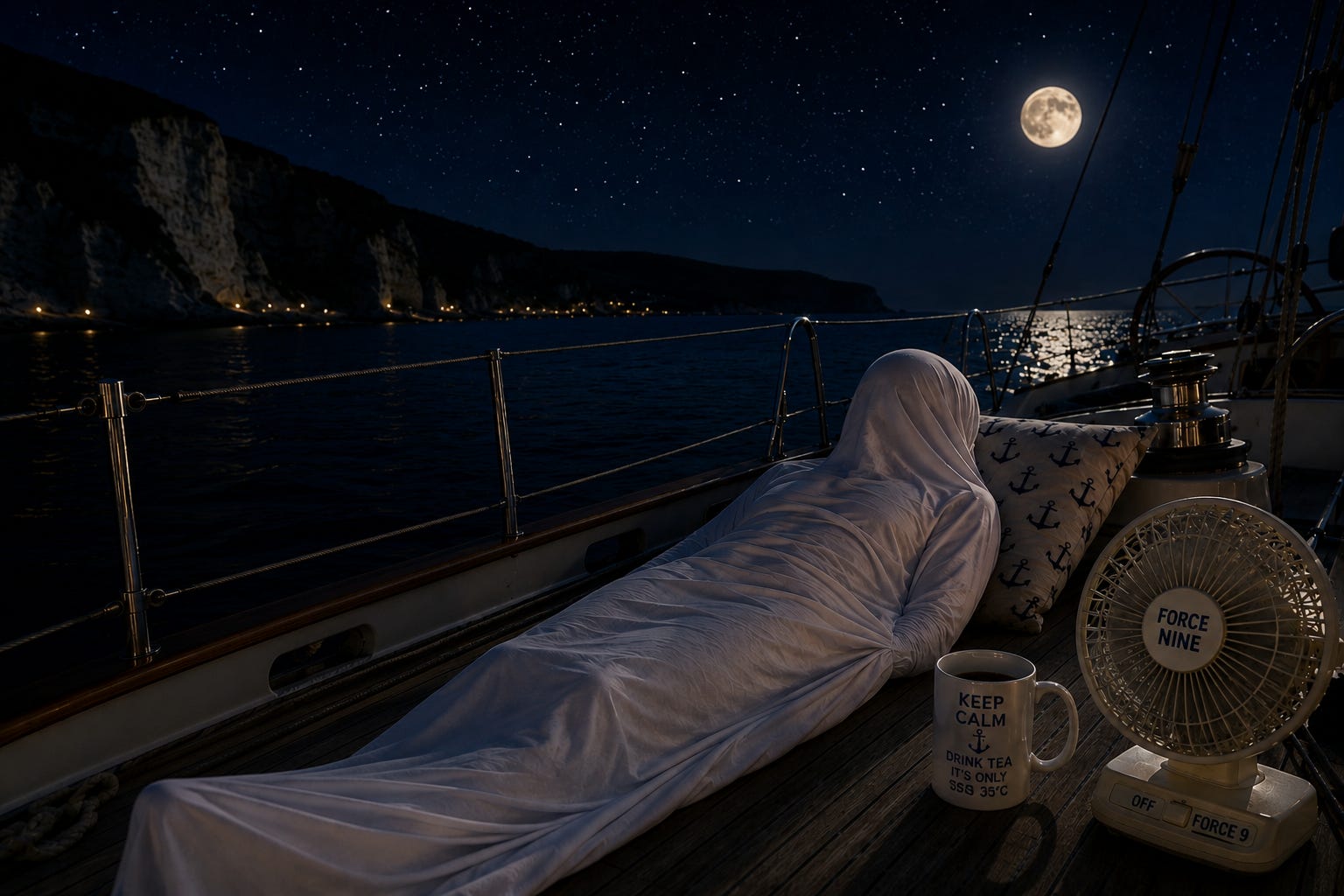
By evening, the cabin had achieved the internal temperature of a successful sourdough starter. Sleeping below was clearly impossible so I took myself up on deck and decided to sleep under the stars.
This sounds romantic.
It was not.
The stars were lovely, but so were the mosquitoes, who had apparently received advance notice of my arrival. To protect myself, I covered myself from head to toe in a fitted single sheet. Not draped elegantly. Not arranged in a casual nautical fashion. Completely covered.
I looked like a dead body in a shroud.
Had another boat passed in the night, I suspect the crew would have quietly alerted the Coastguard to what appeared to be an unexplained death aboard a small vessel off the Dorset coast.
Back on land, matters are no better. We own a fan, although “fan” feels too gentle a word for it. It is not one of those discreet, whisper quiet machines that murmurs soothingly in the corner.
It has, as far as I can tell, two settings.
Off.
And Force Nine.
There is allegedly a Sleep Mode, but this remains a mystery to me. I have pressed every button, consulted the instructions and approached it with the sort of grim determination normally reserved for assembling flat pack furniture. Nothing works.
So each night becomes a negotiation.
If the fan is off, I lie there slowly becoming soup.
If the fan is on, I feel as though I am sleeping beside the engine room of a destroyer during rough weather.
At three in the morning I usually reach the stage where I no longer care whether I am hot or deaf, provided one of them stops.
Of course, we British do have our own heatwave rituals. We discuss the temperature with strangers. We compare rooms in the house as if reporting from different climate zones. We say things like, “There’s a bit of a breeze in the hallway,” and expect this to be treated as useful information.
We buy paddling pools for children and then sit in them ourselves.
We drink tea, because apparently the correct response to overheating is to pour boiling liquid into the body.
We open all the windows, then close them again because someone has read that this is what people do in Spain.
We put wet tea towels on dogs although, according to a recent article, this is not a good idea.
We eat salad for several meals and then realise we are literally staving.
And throughout it all, someone will always say, “It’s not the heat. It’s the humidity.”
This is a sentence that allows the British person to sound meteorologically informed while continuing to complain at full volume.
The truth is that we quite enjoy a weather emergency, provided it does not go on too long. It gives us purpose. We can check forecasts, compare thermometers, issue warnings about leaving the butter out and say “apparently it’s going to break tomorrow” with the authority of a government scientist.
And it will break, of course.
It always does.
In a week or so, we may well be back to grey skies, waterproofs and someone saying, “Well, the garden needed it.” The fan will be shoved back in the cupboard. The fitted sheet will return to its proper function. The boat will once again require jumpers, waterproofs and optimism.
And we will look back fondly on those strange few days when England became the Mediterranean, only with fewer shutters, louder fans and an overheated woman sleeping on deck in a fitted sheet/shroud.
And then what will we have to talk about?
If your daughter et al live in central Canada I suspect they were sleeping peacefully in a really hot cabin. That's where they go on hot summer weekends. I know, I live as far west as you can go in Canada and we have old style English weather. 'They' do say that Victoria is more English than England! Our only heat wave so far this summer did not reach 30. Meanwhile I hope Jodi gave you permission to use her style!!! ;)
This was hysterical. Thanks for brightening my day with the coping strategies from across the pond. Dianne, from near Philadelphia where we have finally ended about 5 days of 90+F heat with "feels likeL temperatures ranging from 100-125F. And yes we hear it all the time, its not the heat but the humidity!